

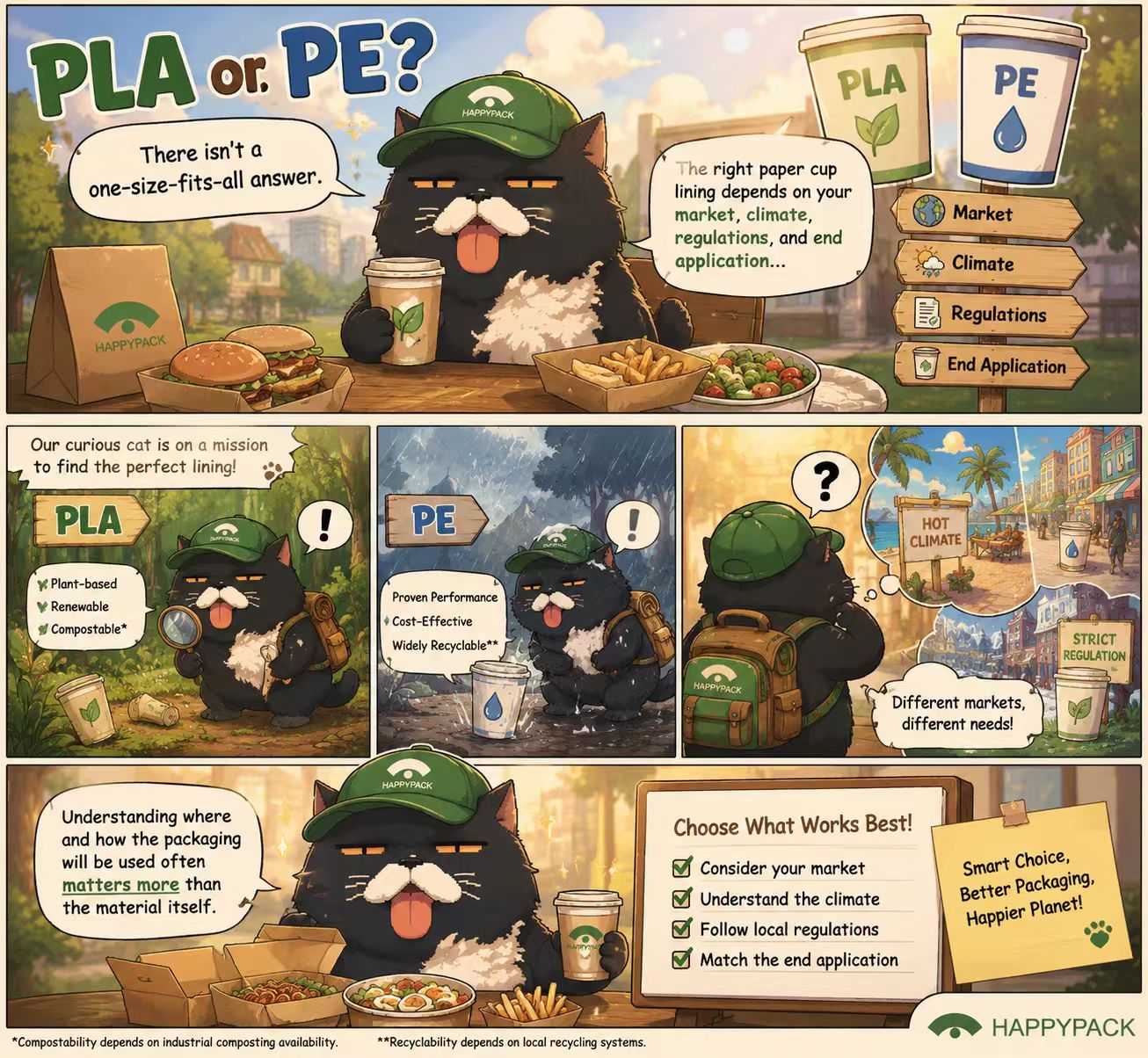
Whether you're supplying coffee shops in Australia, foodservice distributors in Europe, or takeaway businesses in Southeast Asia, choosing the right paper cup lining can directly influence packaging performance, customer expectations, and sustainability goals.
For many buyers, the question isn't simply whether PLA or PE is "better." The real challenge is selecting the barrier material that best suits local market conditions, food applications, and waste management systems.

Understanding the Difference Between PLA and PE
Both PLA and PE are commonly used as barrier coatings for paper cups, paper bowls, and takeaway containers. Their primary function is to prevent liquids and grease from penetrating the paperboard while maintaining the strength of the packaging.
PE (Polyethylene) is a petroleum-based plastic coating that has long been used in food packaging because of its reliable moisture resistance and consistent performance.
PLA (Polylactic Acid) is a bio-based material made from renewable plant resources such as corn starch. It is commonly used in compostable paper packaging designed for markets with suitable industrial composting infrastructure.
Both materials have their advantages, and neither is the right choice for every application.
Common Misconception: Is PLA Always the Better Sustainable Choice?
Not necessarily.
One of the most common misconceptions is that PLA-lined packaging is always the greener option. In reality, its environmental benefits depend largely on what happens after the packaging is used.
Industrial composting facilities are required for PLA to achieve its intended end-of-life performance. In regions where this infrastructure is limited, the practical environmental advantages may be reduced.
This is why many food packaging buyers evaluate local regulations, recycling systems, and composting capabilities before deciding between PLA and PE.
Climate Can Influence Packaging Performance
Climate is another important consideration.
In hot and humid regions, packaging may be exposed to higher temperatures and moisture during storage, transportation, and delivery. Under these demanding conditions, many buyers continue to choose PE-lined paper cups because of their consistent performance and reliable moisture resistance.
In cooler or temperate markets, where sustainability initiatives continue to grow and composting infrastructure is more widely available, PLA-lined paper cups are becoming an increasingly popular option for foodservice operators and distributors.
Rather than applying a single solution worldwide, experienced buyers often select lining materials according to regional market conditions.
Different Applications Require Different Barrier Solutions
The intended use of the packaging is just as important as the material itself.
For example, a 16oz paper cup designed for hot coffee has different performance requirements from a cold beverage cup or a paper bowl used for salads. Likewise, takeaway containers used for hot meals may require different barrier characteristics than packaging intended for chilled foods.
Selecting the right lining involves considering serving temperature, storage time, transportation conditions, and customer expectations—not simply choosing one material over another.
Buying Advice for Distributors and Importers
When evaluating PLA-lined and PE-lined food packaging, buyers should consider several practical questions:
✓ What are the local climate conditions?
✓ Are industrial composting facilities available?
✓ What regulations apply in the target market?
✓ How will the packaging be stored and transported?
✓ What sustainability expectations do your customers have?
Answering these questions often provides a clearer direction than comparing material specifications alone.
Manufacturer's Insight
Choosing between PLA and PE is rarely just a material decision. Successful food packaging depends on matching the right barrier coating with the right paperboard, product design, and manufacturing process.
At Happypack, we manufacture both PLA-lined and PE-lined paper cups, paper bowls, and takeaway containers, allowing distributors and importers to select packaging solutions that best match their local market requirements rather than relying on a one-size-fits-all approach.
Our experience has shown that understanding the final application is often more valuable than simply selecting the newest or most popular material.
Conclusion
There is no universal answer when choosing between PLA-lined and PE-lined paper packaging.
The right solution depends on your market, climate, product application, local waste management infrastructure, and customer expectations.
By understanding these factors—and working with an experienced food packaging manufacturer—buyers can make more informed decisions that balance packaging performance, sustainability objectives, and long-term commercial value.
Author
Neil Nie | Business Development | Happypack
Email: neil@nbhappypack.com